







|
|
|
Last updated: 7 May 2025. Click About This Website for update list. This site does not use cookies or annoy you with banners, popups, ads or anything else. Nor does it beg for money just for being here. All I hope is that you just enjoy it.
For over 25 years the most stable and extensive resource on the internet for pipe and electronic organs
As this site is now into its third decade it's not surprising that it has grown into quite a big place. So if you are new to it, you might first want to hit the Sitemap button in the navigation bar above to get a quick idea of the general layout. Maybe try skimming the material revealed by the other buttons as well. Then, when you feel ready to dive in more deeply, the main hub of the site is the Complete Articles page which gives you instant access to over 120 detailed articles dealing with technical aspects of both pipe and electronic organs. You can also scroll down this page a little to the Google search box below to quickly identify articles of interest. And the navigation bar stays with you on all HTML pages, so you can easily find a way out of any labyrinth you might feel trapped in - if you are desperate just hit the Home button and you'll get back to here. While browsing, why not also listen to over 4½ hours of music played on the three manual organ below and the Prog Organ virtual pipe organ here?
There is a lot of information here and none of it costs anything. Putting this in context, the site reached its twenty-fifth birthday in 2024 by which time it comprised over 120 articles totalling some 850,000 words. Comfortably exceeding the word count of the Bible, this compares to nine average-sized novels. So the site now spans the lifetime of an entire new generation of those interested in the organ. Most users dip into it and use it as a work of reference, rather than attempting to read it in its entirety. And, as mentioned already, do make full use of the Google search box below.
LATEST ARTICLE
The Revd Noel Bonavia-Hunt -
SEARCH THIS SITE
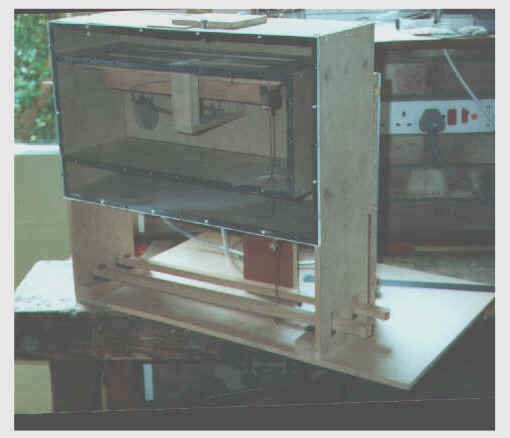
The picture above is of a test rig used for experiments on pipe organ valves, such as those described in the articles entitled Calculating Pallet Size, Touch Relief in Mechanical Actions and Response Speed of Electric Actions. These can also be accessed from the Complete Articles page where summaries are also available.
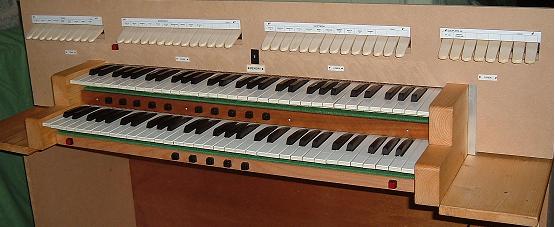
Pictured above is an experimental digital organ which simulates many different pipe organs (Prog Organ). Also see the article entitled Re-creating Vanished Organs.
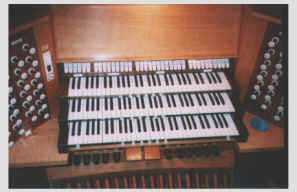
The three manual electronic organ above is a dual purpose instrument containing both "straight" and "theatre" voices, designed and made by the author in the 1980s. It is tuned to the author's Dorset Temperament with the addition of some impure octaves as described in Keyboard Temperaments with Impure Octaves. A full specification can be downloaded here (PDF file).
The things they say:
Hear it: These recordings span some years and they have been made in various rooms and auditoria since the organ was built in the 1980s. The older tracks were made using analogue equipment and some were recorded acoustically using microphones, hence the occasional noises due to piston thuds and page turns, etc. Other tracks were captured electrically. All are of real players performing in real time - no synthetic MIDI 'performances' here. I have not got round yet to normalising the volume settings of all the tracks so they are compatible with each other, therefore you might wish to adjust the volume between tracks depending on which ones you select. Do not be alarmed if some tracks appear to start with an excessive noise level - this simply means they were recorded at a higher level than others. Just turn the volume down to suit. In any case, it is a wise precaution to always begin playing each track at a low level to protect your audio equipment and your ears from unexpectedly high signal levels when the music begins. Although the instrument has 13 ranks of theatre organ voices in addition to its 'straight' sounds (see specification), copyright considerations preclude the inclusion of much theatre-style music here. Playing time 1 hour 35 mins approx.
Website copyright © 1999-2025 C E Pykett. All rights reserved. See About this Website.
|